Types of Methods in Java
Java methods can be grouped by two things: whether they accept parameters and whether they return a value.
Four Types of Methods
The diagram below gives an overview of all four combinations.
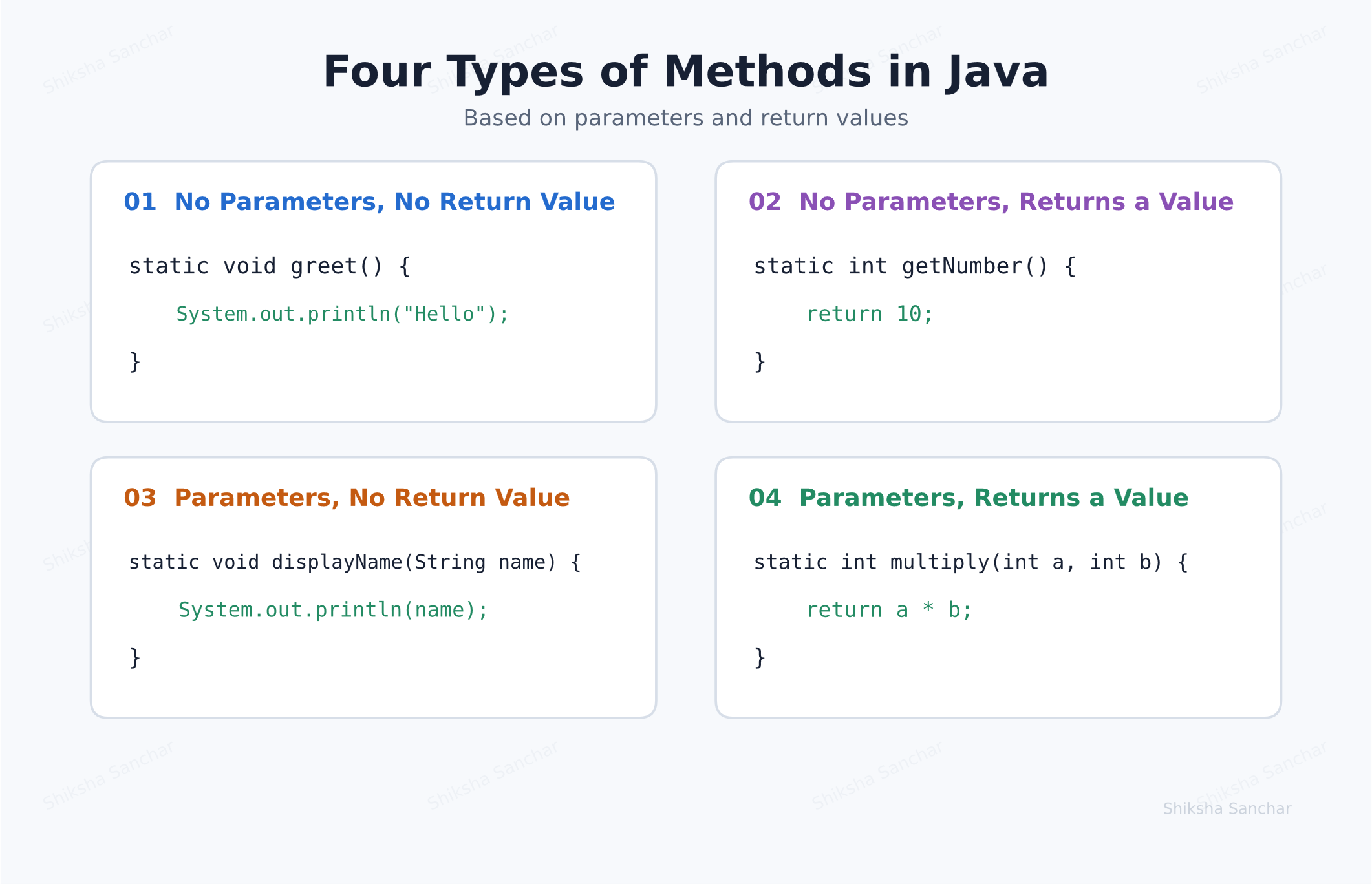
Explanation:
Each method belongs to one type based on its parameters and its return value. The examples below show every type separately.
Example 1: No Parameters, No Return Value
class ShikshaSanchar {
    static void showMessage() {
        System.out.println("Hello Java");
    }
    public static void main(String[] args) {
        showMessage();
    }
}
Output:
Hello Java
Explanation:
showMessage() takes no parameters and uses void, so it does not return a value.
Example 2: No Parameters, Returns a Value
class ShikshaSanchar {
    static int getNumber() {
        return 10;
    }
    public static void main(String[] args) {
        System.out.println(getNumber());
    }
}
Output:
10
Explanation:
getNumber() takes no input and returns the integer 10.
Example 3: Parameters, No Return Value
class ShikshaSanchar {
    static void displayName(String name) {
        System.out.println("Name: " + name);
    }
    public static void main(String[] args) {
        displayName("Simran");
    }
}
Output:
Name: Simran
Explanation:
name is a parameter. The method prints it but returns no value.
Example 4: Parameters, Returns a Value
class ShikshaSanchar {
    static int multiply(int a, int b) {
        return a * b;
    }
    public static void main(String[] args) {
        System.out.println(multiply(4, 5));
    }
}
Output:
20
Explanation:
multiply() accepts two parameters and returns their product.
Key Points:
- A method may have parameters, a return value, both, or neither.
- Use
voidwhen a method does not return a value.